What is freight broker software?
Freight broker software is a specialized transportation management system (TMS). Intermediaries use it to match shippers with motor carriers. Unlike a general TMS for asset-based fleets, this platform does not dispatch physical trucks. It focuses on capacity sourcing and load execution.
Core features of freight broker software include:
- Carrier Sourcing: It connects to external load boards and internal capacity networks.
- Load Execution: Dispatchers track shipments from pickup to delivery.
- Margin Management: Brokers quote spot rates and protect transaction profitability.
- Back-Office Billing: The system automates invoicing and factoring workflows.
- Carrier Compliance: It verifies operating authority and FMCSA safety ratings.
Most freight broker software gets graded on one question. Can it find a cheap carrier fast? That metric misses the point. A truck matched to a load in six seconds still gets impounded at a weigh station. An expired CDL can do that. A wrong hazmat placard can do that. The gap between “booked” and “compliant” costs brokerages real money every quarter.
This guide covers what freight broker software actually does. It also covers where the legacy category falls short. It outlines what modern operations demand from carrier onboarding through pre-departure validation. You will walk away with a framework for evaluating tools based on your brokerage size. You will also get a pilot testing checklist. You will see where compliance automation fits into the stack.

Table of Contents
What Freight Broker Software Does and How It Differs From a General TMS
Freight broker software is a category of tools designed for intermediaries who match shippers with carriers. A general transportation management system (TMS) typically serves asset-based fleets. It handles dispatch, driver scheduling, and maintenance logs for trucks the company owns. Broker-focused software skips the fleet management layer. It concentrates on load posting, carrier sourcing, rate negotiation, and margin tracking.
The distinction matters at purchase time. A general TMS will include modules you never touch. Broker-specific platforms invest that development budget into daily-use features. Load board integrations matter. Automated carrier onboarding matters. Back-office billing tied to each transaction matters.
Core Modules in a Broker Platform
Most modern platforms bundle four operational layers. Load management handles quoting, booking, and status tracking from pickup to delivery. Carrier sourcing connects to external load boards and internal carrier pools. Back-office automation covers invoicing, factoring integration, and accounts receivable. Reporting rolls margin data, lane performance, and carrier scorecards into dashboards.
Some platforms add a fifth layer. Compliance and document management. This is the module most buyers overlook during demos. It is also the module that determines whether a load moves without incident.
Why Legacy Freight Systems Hold Brokerages Back
Legacy freight broker software was built for a simpler regulatory environment. The original architecture treated compliance like a static checkbox. Verify a carrier’s MC number at onboarding. Collect a certificate of insurance. Move on. That approach worked when brokerages moved fifty loads a week. It breaks at scale.
Data Silos Kill Visibility
Older systems store carrier data in one database. Load data sits in another. Compliance documents end up in a file cabinet or shared drive. When a dispatcher must confirm active insurance, the answer lives elsewhere. That lookup takes time. Under pressure, it gets skipped.
Data silos also block reporting. You cannot calculate true cost per load if key data lives in separate places. Rate data sits in one tool. Detention charges sit in another. Compliance fines sit in a third. Legacy platforms force manual reconciliation. Manual work introduces errors. It also delays invoice cycles.
No Real-Time Validation
The deeper problem is architectural. Legacy tools treat compliance as a one-time event. They verify documents at carrier onboarding. Then they assume nothing changes. CDLs expire. Insurance policies lapse. Hazmat endorsements get revoked. A system that checked once and stored the result is a liability. It is not a safeguard.
According to Supply Chain Management Review, rapid AI adoption is outpacing the ability to govern compliance and cyber risks. The same pattern plays out in freight brokerage. New tools get layered on top of old compliance logic. That logic was not built for continuous validation.
The Freight Brokerage Tools Modern Operations Require
Buying freight broker software in 2025 requires evaluating tools against workflows, not feature lists. A platform that advertises 200 integrations means nothing. It fails if your key integrations are shallow or poorly maintained.
Load Board Integration That Goes Beyond Posting
Load board integration is the most requested feature in broker demos. The baseline expectation is simple. Post a load, receive carrier responses, and book. That baseline is table stakes now.
Better platforms automate the response loop. When a carrier responds, the system checks authority status, insurance, and safety rating. It does that before the dispatcher sees the bid. Auto-booking rules can accept qualified carriers within a rate threshold. Human intervention is not required. Status sync pushes tracking updates back to the load board. Shippers see movement without calling your office.
The integration depth varies widely. Some platforms connect to DAT and Truckstop at the API level with real-time sync. Others use screen-scraping or batch uploads. That introduces lag. Ask vendors for their sync frequency during evaluation.
Carrier Onboarding That Reduces Risk and Speed
Carrier onboarding is where compliance starts. A strong onboarding module validates MC and DOT numbers against FMCSA records automatically. It pulls insurance certificates and flags policies approaching expiration. It runs fraud screening against known double-brokering patterns.
The best platforms compress onboarding from days to hours. Document collection happens through carrier-facing portals. Drivers upload W-9s, insurance certificates, and authority documents. Approval workflows route completed packets to compliance staff. Pass or fail indicators get applied upfront.
Weak onboarding modules create downstream problems. If you onboard a carrier without verifying a hazmat endorsement, you inherit the liability. That hits when the carrier hauls regulated materials. The cost of thorough onboarding is always lower than one compliance violation. Always.
How to Evaluate Freight Broker Software for Your Brokerage
A five-person startup brokerage and a 200-agent operation need different platforms. Evaluation frameworks that ignore brokerage size produce bad purchasing decisions.
New Brokerages: Under 100 Loads Per Month
Small brokerages need affordability and fast onboarding. A complex enterprise TMS will overwhelm a team of three. Look for platforms with month-to-month pricing, built-in load boards, and basic accounting integration. Skip platforms that require dedicated IT staff for configuration.
The trade-off is simple. Entry-level platforms often lack advanced compliance automation. You will handle CDL verification and insurance monitoring manually. Or you will use separate tools. That is acceptable at low volume. It becomes a bottleneck past 200 loads per month.
Growing 3PLs: 200 to 1,000 Loads Per Month
Mid-size operations face the hardest evaluation challenge. You need scalability without enterprise complexity. Prioritize platforms that offer carrier scoring, automated check calls, and integration with your accounting system. API access matters here. You will start connecting other tools.
This is also the stage where compliance gaps start costing real money. A single FMCSA fine or detained shipment erases margin on dozens of loads. Invest in platforms with continuous insurance monitoring and document expiration alerts.
High-Volume and Multi-Mode Operations
At enterprise scale, the software must handle intermodal workflows, cross-border documentation, and multi-currency billing. Total cost of ownership becomes the deciding metric. Implementation timelines stretch to months, not days. Migration risk is real.
KPMG’s 2026 supply chain trends analysis confirms that AI adoption is scaling from proof-of-value pilots to embedded platforms in planning and risk management. High-volume brokerages that delay platform modernization will compete against automated compliance operations. Those rivals will not wait.
The Compliance Gap That Legacy Freight Broker Software Ignores
Here is the operational reality most software vendors avoid discussing. Every feature listed above becomes irrelevant if the truck gets stopped. That includes load matching, rate optimization, carrier onboarding, and load board integration.
A missing hazmat placard grounds the shipment. An expired CDL grounds the driver. An out-of-date insurance certificate exposes the brokerage to liability. Legacy freight broker software treats these as edge cases. They are not edge cases. They are Tuesday.
If you do not have a bulletproof DOT compliance checklist, legacy software cannot save you from an audit.
Passive Databases vs. Semantic Validation
Legacy systems store documents. They do not interpret them. A PDF of a hazmat placard sits in a folder. Nobody verifies whether the UN number matches the commodity on the bill of lading. Nobody checks whether the placard is mounted on the trailer. The system recorded the upload. It did not validate the content.
Semantic validation is a different architecture. It reads the document, extracts relevant data points, and compares them against the shipment record. A photo of a placard gets analyzed. Is the UN number visible? Does it match the declared hazardous material? Is the placard positioned correctly? This is not a database query. This is inference.
The gap between storage and validation is where compliance failures live. Every broker who has received a weigh station call knows the difference.

Pre-Departure Checks: The Missing Layer
The highest-risk moment in any shipment is the fifteen minutes before the truck leaves the facility. The driver has loaded. The paperwork is theoretically complete. Nobody is checking. Legacy systems have no mechanism for a pre-departure compliance sweep. They were not designed to interact with the physical world.
A pre-departure check needs to verify CDL status, hazmat placarding and endorsements, insurance validity, and load-specific documentation in real time. It needs to happen at the point of departure, not in a back office two hours later. It must work without forcing drivers to download another app.
How the Truzer Ontology Redefines Pre-Departure Compliance
Truzer approaches this problem from a different angle. Truzer did not build another broker tool that bolts compliance onto a load board. Truzer built an AI Integrator. It connects every data source in the operation. It creates a unified digital twin called the Ontology.
The Ontology is not a dashboard. It is a semantic model of your entire operation. Carriers, drivers, loads, documents, routes, and regulatory requirements link inside one knowledge graph. When a driver’s CDL expires, the Ontology does not send an email. It flags every active and upcoming load for that driver. It blocks dispatch until the issue is resolved.
The AI Bot: Pre-Departure Validation via SMS
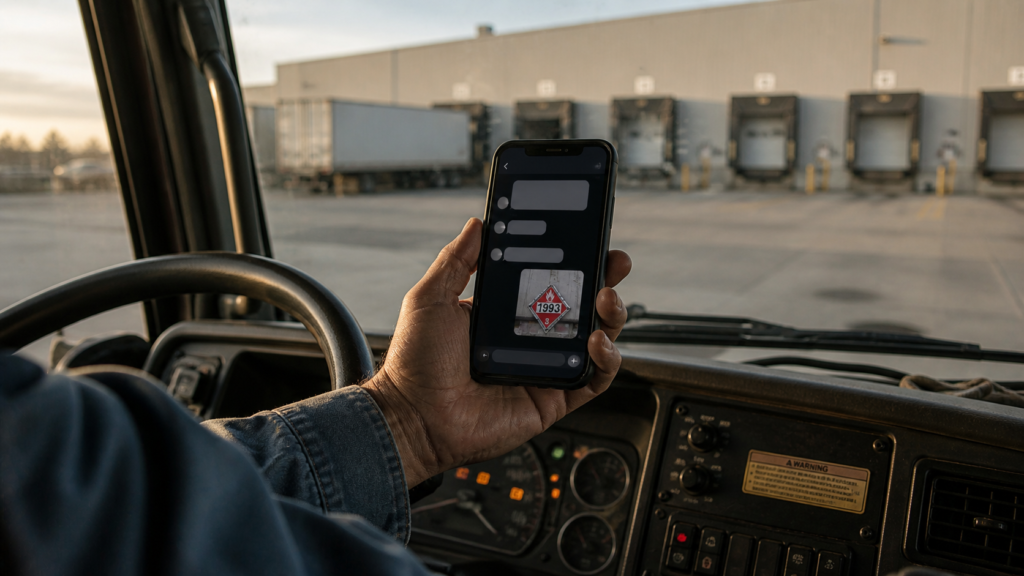
Truzer’s AI Bot runs pre-departure checks through SMS. No app download. No login screen. No driver app fatigue. The driver receives a text requesting a hazmat placard photo. The bot analyzes the image semantically. It reads the UN number. It confirms a match to the bill of lading. It verifies the placard is visible and correctly positioned.
If the check passes, the driver rolls. If it fails, the bot flags the discrepancy to dispatch. It includes a specific description of the problem. The entire interaction takes under two minutes.
Every interaction creates an immutable audit trail. Photos, timestamps, GPS coordinates, and validation results get locked into the record. When an auditor or attorney asks for proof, you hand over a chain of evidence. No binders. No scramble.
Security and Data Integrity
The Ontology encrypts all data with AES-256 at rest and TLS 1.3 in transit. Access controls use scoped tokens. Dispatchers see only data relevant to their loads. AI inference runs in isolated environments. Driver photos and document images never pass through shared processing pipelines.
This architecture addresses a concern in ASCM’s 2026 supply chain trends report. The report highlights the need for integrated compliance and risk management frameworks. Those frameworks replace rigid legacy processes with data-driven automation.
A 5-Step Pilot Plan Before You Replace Your Current System
Switching freight broker software carries real migration risk. A structured pilot reduces that risk. It also avoids committing your entire operation.
Step 1: Define success criteria before you demo. Pick three metrics that matter. Time to onboard a new carrier. Dispatcher adoption rate. Compliance check completion percentage. Write them down before any vendor call.
Step 2: Run the pilot on a single lane or customer. Isolate one book of business. Route those loads through the new platform. Keep everything else on the existing system. This limits blast radius if something breaks.
Step 3: Test integrations under real conditions. Connect the pilot to your actual load boards and accounting system. Sandbox integrations do not reveal sync issues. Production volume exposes them.
Step 4: Measure against your criteria at day 14 and day 30. Two weeks reveals adoption friction. Thirty days reveals whether the system handles edge cases. That includes cold chain loads with temperature documentation. It includes oversized freight requiring special permits. It includes hazmat shipments needing placard verification.
Step 5: Get dispatcher feedback before signing the annual contract. The people using the tool eight hours a day will identify problems. Demos hide those problems. Their buy-in determines whether the migration succeeds.
Stop Buying Features. Start Buying Operational Integrity.
The freight broker software market is crowded with tools that optimize one slice of the workflow. Load matching. Rate negotiation. Carrier scoring. Each tool solves a real problem. None of them solve the problem that stops trucks.
Compliance is not a feature. It is the foundation that every other feature depends on. A brokerage that books 500 loads a day but cannot verify a hazmat placard at departure is running on luck. Luck is not a strategy.
Truzer’s Ontology connects the data that legacy platforms keep in silos. The AI Bot validates compliance at the moment that matters most. Before the truck moves. No app downloads. No manual lookups. No gaps between “booked” and “road-legal.”