
01
Connect Everything
Your TMS, ERP, telematics, IoT, EDI. All of it. Truzer aggregates the complex and maps it into a single unified ontology. No rip-and-replace. No 18-month implementation. Your systems keep running.
Your TMS runs your operation. Truzer makes it intelligent. Production-grade AI for logistics, deployed on your existing TMS in 48 hours. Backhaul matching, pre-departure compliance, real-time visibility, driver SMS. No migration. No replacement. No new security story.
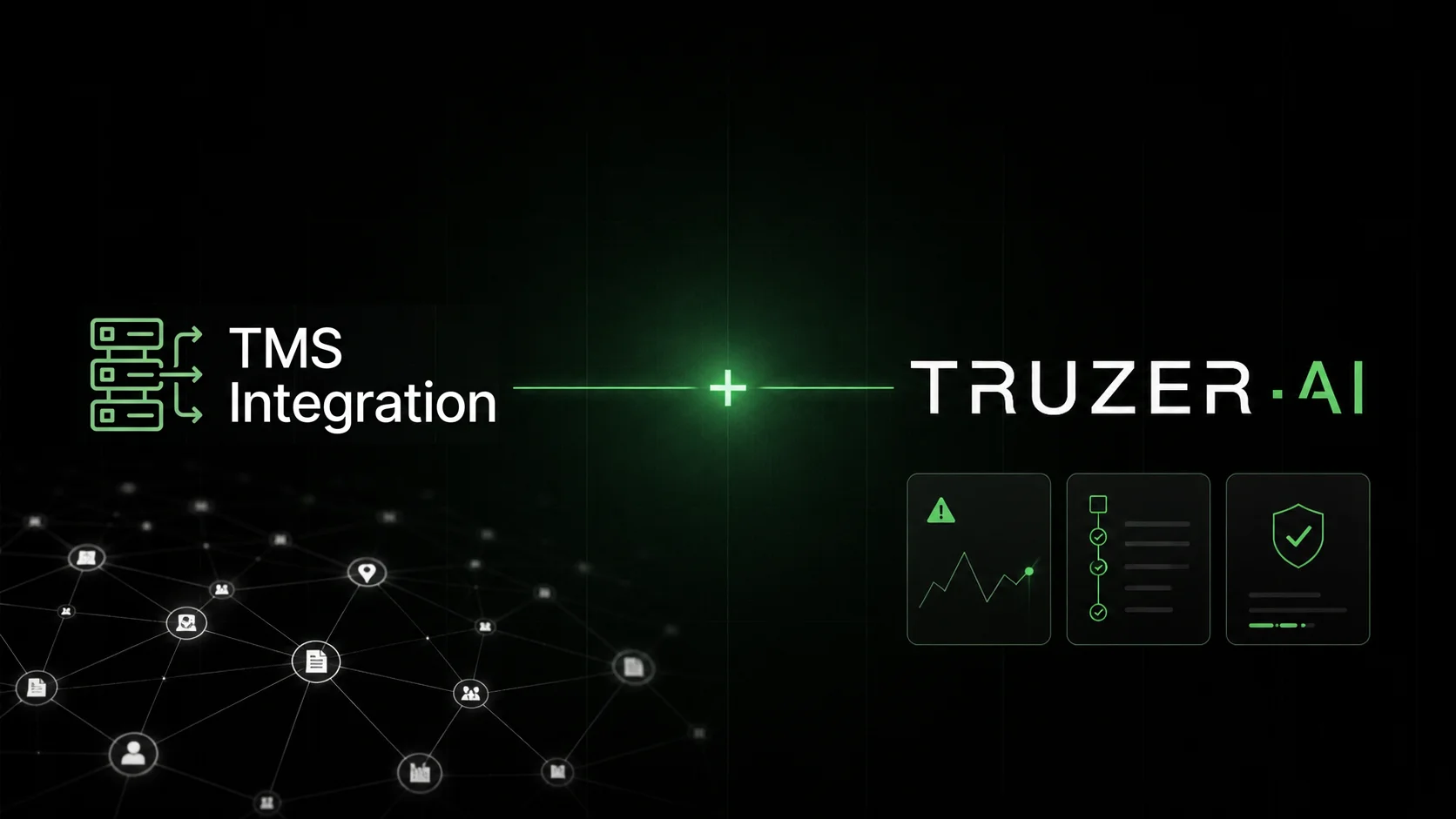
Ontology layer for any TMS. Production-grade AI for logistics. No migration, no replacement, no new security story.
| 01
The Ontology Your TMS Doesn’t Have Your TMS is a ledger of transactions. It records what happened. It does not understand how the operation actually runs. Truzer builds the ontology layer your TMS does not have, mapping every load, asset, lane, driver, and constraint into a digital twin AI can act on. |
| 02
AI That Knows Freight AI grounded in your operational reality. Backhaul matches that respect lane density and HOS. Compliance checks that read your actual permit stack. ETAs built from real geofence pings, not hopeful guesses. |
| 03
Bi-Directional Sync With The TMS You Already Run Truzer reads from your TMS, writes back to your TMS, and inherits the integrations you have already paid for. McLeod, MercuryGate, SAP TM, Manhattan, Trimble, Turvo, Descartes, Motive, Samsara, AscendTMS, Rose Rocket, PortPro, or homegrown. |
AI outcomes the board can see, deployed on infrastructure the architecture team already trusts.
Your TMS already runs the operation. Truzer makes the outcomes the board asks about. Backhaul matches that hold up under HOS. Pre-departure compliance that prevents OOS violations. ETAs the customer trusts. Drivers you stopped chasing.
Truzer reads your TMS, never replaces it. Read-only by default. Bi-directional only on the use cases you authorize. AI inference runs in an isolated encrypted namespace. No new ports, no new vendors in your data path, no new security review.
Every business we’ve transformed over the past decade was inflicted with the same limitations. Here’s how we fix yours.
Your TMS, ERP, telematics, IoT, EDI. All of it. Truzer aggregates the complex and maps it into a single unified ontology. No rip-and-replace. No 18-month implementation. Your systems keep running.
Right away you’re immersed into a complete visual experience. Seeing everything a real time. Your whole operation, stupidly visible. Not yesterday’s report. Not a dashboard silo. The truth, live, now.
The ontology doesn’t just show your data. It maps how every asset, route, team, customer, and regulation connects to each other. When one thing changes, you already know what it affects. All truth. No fiction.
AI agents monitor your operation 24/7. They flag exceptions, lock down compliance violations, send proactive customer updates, and surface revenue opportunities. Grounded in your ontology. Not hallucinated from generic training data.
Most logistics operations bleed margin in the gap between what the TMS knows and what the spreadsheet knows. Here is the seven-discipline framework that closes it
TMS integration is the practice of connecting your transportation management system to other tools, data sources, and AI capabilities without replacing the TMS itself. It lets the TMS keep its role as the system of record while extending it with capabilities the TMS does not have natively. Truzer is a TMS integration that adds an ontology layer and pre-built AI use cases on top of the TMS you already run.
TMS integration eliminates the manual reconciliation work dispatchers and ops managers do every day. Truzer's ontology unifies data the TMS holds (loads, lanes, assets, drivers) with data the TMS does not (compliance status, real-time geofence pings, driver SMS, customer rules) and runs AI against the unified view. The result is automated backhaul matching, pre-departure compliance, real-time visibility, and bi-directional driver SMS, all writing back into the TMS in real time.
A TMS runs transportation: loads, carriers, dispatch, freight billing, EDI. A WMS runs the warehouse: receiving, putaway, inventory, picking, shipping. The TMS is the system of record for freight in motion; the WMS is the system of record for inventory at rest. Truzer's ontology spans both, so backhaul matches respect inventory availability and pre-departure compliance reads warehouse-side documentation in real time.
Yes. Truzer connects to McLeod, MercuryGate, SAP TM, Manhattan, Trimble, Turvo, Descartes, Motive, Samsara, AscendTMS, Rose Rocket, PortPro, and homegrown systems. The connection uses read-only credentials, an API key, or an EDI feed. Pick the path your IT team already trusts. If your TMS is not listed, the integration team can scope it on the discovery call.
ROI lands in four places: empty miles eliminated, OOS violations prevented, exception-management hours reclaimed by dispatch, and ETAs the customer trusts. Truzer ships pre-built use cases that deploy in 48 hours, so the first measurable outcome arrives in week one rather than year two. The board sees AI in the operating metrics the next reporting cycle.
Truzer reads every policy page, cites every field, and flags every gap — before a denial reaches your desk.