
01
Connect Everything
Your TMS, ERP, telematics, IoT, EDI. All of it. Truzer aggregates the complex and maps it into a single unified ontology. No rip-and-replace. No 18-month implementation. Your systems keep running.
Freight optimization software built for VPs of Logistics, Directors of Operations, and 3PL coordinators running mixed fleets. Every load, lane, asset, and driver scored against the operation as it is right now. No nightly batch. No data migration.
Freight optimization software is a platform that scores loads, lanes, carriers, and exceptions in real time to cut empty miles and protect margin. It sits on top of a TMS, a WMS, an ELD, and customer EDI feeds, reading the data those systems already produce. Most platforms run a nightly batch refresh, scoring decisions against a snapshot pulled overnight. Modern freight optimization software runs on a live data layer, scoring decisions against the operation as it is right now. The output is dispatch and carrier decisions grounded in the live state of every load, lane, asset, and driver, not in last night's data.
What does freight optimization software actually do?
A modern freight optimization platform handles the parts of dispatch, carrier management, and lane planning that a TMS alone cannot score in real time:
Truzer is the freight optimization software built around the ontology, an immutable audit trail of every dispatch, carrier, and lane decision, grounded in the live state of the operation, not in last night’s snapshot.

Craig and Michael have spent 10+ years aggregating the complex for 1,000+ organizations. In freight, the complex shows up as backhauls scored against last month's lane density, carriers ranked on vendor-reported numbers, and dispatchers calling drivers about exceptions the geofence already flagged hours earlier. Truzer.ai is what they built so the operators living with that reality every day stop optimizing on hope.
Book a Founder Call


Built for VPs of Logistics, Directors of Operations, and 3PL coordinators running empty-leg elimination at scale. Sits on top of your existing TMS.
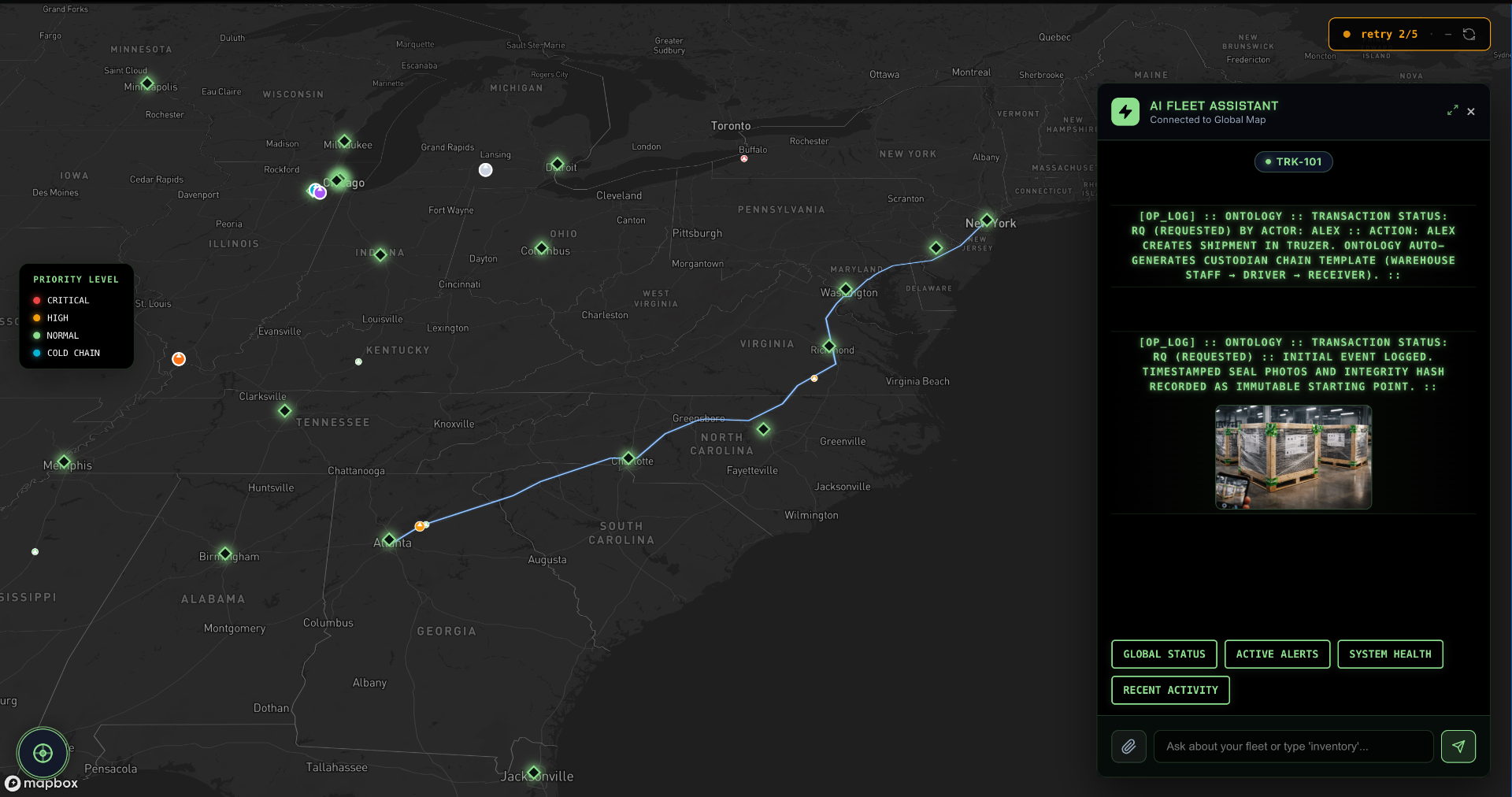
Pull every outbound load and every available return leg into one ontology. TMS load data, ELD pings, carrier capacity, lane density, and customer windows all land in the same workflow. No more "did anyone match this backhaul?"
The AI Bot scores every carrier on price, on-time history, claim rate, and lane availability against your own freight. New scores compute weekly. The next tender goes to the carrier the data ranks highest.
Every late shipment, every missed appointment, every damage event surfaces in one control tower the moment the geofence pings. Triage happens before the customer calls.
Every optimization decision gets a timestamp, an actor ID, and an evidence hash at the source. Events land in Truzer's ontology, a live digital twin of every load and carrier decision. When a customer asks why a load was assigned the way it was, the answer is one click back.
Two ways to run freight optimization in 2026. One of them is costing you.
Backhaul matching
Carrier scoring
Exception detection
Audit trail
Margin impact
Deployment
Commitment
48 hours from now, your next dispatch is either still scored against last night or it is matched against the operation as it is right now.
Every business we’ve transformed over the past decade was inflicted with the same limitations. Here’s how we fix yours.
Your TMS, ERP, telematics, IoT, EDI. All of it. Truzer aggregates the complex and maps it into a single unified ontology. No rip-and-replace. No 18-month implementation. Your systems keep running.
Right away you’re immersed into a complete visual experience. Seeing everything a real time. Your whole operation, stupidly visible. Not yesterday’s report. Not a dashboard silo. The truth, live, now.
The ontology doesn’t just show your data. It maps how every asset, route, team, customer, and regulation connects to each other. When one thing changes, you already know what it affects. All truth. No fiction.
AI agents monitor your operation 24/7. They flag exceptions, lock down compliance violations, send proactive customer updates, and surface revenue opportunities. Grounded in your ontology. Not hallucinated from generic training data.
Truzer connects to McLeod, MercuryGate, SAP TM, Manhattan, Trimble, and any homegrown TMS via read-only credentials, an API key, or an EDI feed. The TMS keeps running. Your team keeps working. The ontology fills the gap between transaction records and operational reality.
Most logistics operations bleed margin in the gap between what the TMS knows and what the spreadsheet knows. Here is the seven-discipline framework that closes it
Freight optimization software is a platform that scores loads, lanes, carriers, and exceptions in real time to cut empty miles and protect margin. It sits on top of a TMS, a WMS, an ELD, and customer EDI feeds, reading the data those systems already produce. Modern freight optimization software runs on a live data layer rather than a nightly batch refresh, so dispatch and carrier decisions reflect the operation as it is right now.
A TMS is the system of record for loads, carriers, and freight billing. Freight optimization software sits on top of the TMS and scores the decisions the TMS executes. The TMS records what happened. Freight optimization software decides what should happen next, grounded in the live state of every load, lane, asset, and driver. Truzer reads from the TMS and writes optimization decisions back into it as structured records, so dispatchers see the recommendation in the system they already use.
Truzer reads carrier performance from the TMS and the ELD, then scores every carrier weekly on price, on-time history, claim rate, and lane availability against your own freight. The next tender goes to the carrier the data ranks highest. The TMS still issues the tender, the carrier still hauls the load, and the audit trail of how the carrier was selected is logged in the ontology.
Truzer sits on top of the TMS, WMS, ELD, and customer EDI feeds and ingests data through the existing API or flat-file connection. Optimization decisions, audit events, and exception flags flow back into the TMS as structured records, so dispatchers never re-key. Most carriers go live in 48 hours with no rip-and-replace. The integration covers the common freight stacks and adapts to custom builds on the same timeline.
es. Truzer logs every optimization decision with a timestamp, an actor ID, and an evidence hash, stored in an immutable digital twin of the freight network. When a customer asks why a load was assigned the way it was, or an auditor asks how a carrier was selected, Truzer returns one indexed record per decision with the underlying data the AI scored. The audit trail does not get reconstructed because it was built at the source.
Book a call with Craig and Michael. Walk through your stack. See your own backhaul match, your own carrier scorecard, your own decision trail, running on Truzer.