What is a DOT compliance checklist?
A DOT compliance checklist is the operational document that maps every federal requirement a motor carrier must satisfy before a vehicle moves. It turns broad Federal Motor Carrier Safety Administration (FMCSA) regulations into specific tasks with clear ownership and strict deadlines. This structure ensures your fleet stays audit-ready every day, not just when an investigator shows up.
The checklist covers seven critical compliance buckets:
- Driver Qualification Files (DQF): Current CDL endorsements, medical cards, and annual MVR pulls.
- Hours of Service (HOS): Verified ELD logs and supporting documentation.
- Vehicle Inspections: Pre-trip and post-trip Driver Vehicle Inspection Reports (DVIR).
- Cargo Securement: Physical evidence of straps, tie-downs, and load stability.
- Hazmat Protocols: Correct placarding thresholds and emergency response information.
- Drug and Alcohol Testing: Random pool selections and Clearinghouse queries.
- Preventive Maintenance: Systematic repair logs and annual inspection records.
The outcome is an immutable audit trail. This includes current documents, validated photos, and actor-identified timestamps tied to the specific driver and asset.
A single missed inspection form cost one fleet $16,000 in fines last quarter. The driver had a clean record. The truck passed its last roadside check. But the DOT compliance checklist binder sitting in the dispatch office had a gap. One unsigned DVIR from three weeks prior. That gap turned a routine audit into a five-figure penalty.
This guide breaks down every requirement your fleet needs to meet in 2026. It covers driver qualification files, hours of service, vehicle inspections, drug testing, audit triggers, and the newest rule changes. Each section translates the regulation into the specific task. It also covers the document and the owner.

Table of Contents
What Is DOT Compliance and Why FMCSA Rules Control Your Fleet
DOT compliance is the legal obligation every commercial motor vehicle operator has to meet federal safety standards set by the Department of Transportation. The Federal Motor Carrier Safety Administration (FMCSA) enforces those standards. If you operate vehicles over 10,001 pounds or haul hazmat at any weight, FMCSA regulations apply.
The rules cover everything from who you hire to how you maintain your trucks. They dictate how long a driver can sit behind the wheel. They define what paperwork you store and for how long. They set the testing protocols for drugs and alcohol.
Compliance Is Not Optional. It Is Operational.
Fleet managers treat compliance as a back-office task. That is the wrong frame. Compliance failures directly affect your CSA (Compliance, Safety, Accountability) scores. Poor CSA scores trigger more frequent roadside inspections. They also raise insurance premiums and put your operating authority at risk.
A carrier with high UNSAFE DRIVING or HOS scores gets flagged for intervention. That intervention ranges from warning letters to full compliance reviews. Lose the review and you lose the authority to operate.
The gap most operators face is not ignorance of the rules. It is the inability to verify each driver, each truck, and each document stays current every day. Paper checklists and static dashboards do not solve this. They mask the problem until an auditor shows up.
DOT Compliance Checklist for 2026: Core Requirements Every Fleet Must Meet
The complete checklist spans eight operational areas. Each one carries its own documentation burden, retention period, and audit risk. Here is the master list organized by compliance bucket.
- Driver Qualification Files (DQFs): application, MVR, medical certificate, road test, previous employer verification
- Drug and Alcohol Testing: pre-employment, random, post-accident, reasonable suspicion, return-to-duty, FMCSA Clearinghouse queries
- Hours of Service (HOS) and ELD Records: daily logs, supporting documents, ELD malfunction reporting
- Vehicle Inspections and DVIRs: pre-trip, post-trip, annual inspections, DVIR sign-offs
- Preventive Maintenance: scheduled service, repair documentation, tire and brake records
- Insurance and Operating Authority: MCS-90/BMC-91 filings, USDOT number, MC number, UCR registration
Missing a single element in any bucket creates an audit finding. Missing several elements across buckets signals a systemic failure to the FMCSA investigator.
Document Retention Schedule: What to Keep and for How Long
Knowing what to file is half the battle. Knowing how long to keep it is the other half. The table below maps document types to their required retention periods. It also shows the owner and audit risk.
| Document Type | Retention Period | Owner | Audit Risk If Missing |
|---|---|---|---|
| Driver Application | Duration of employment + 3 years | HR / Safety Manager | High: triggers DQF violation |
| MVR (Motor Vehicle Record) | 3 years | Safety Manager | High: must be pulled annually |
| Medical Examiner’s Certificate | 3 years | Driver / Safety Manager | Critical: driver placed out of service |
| ELD / HOS Records | 6 months | Fleet Manager | High: per-day-per-driver fines |
| DVIRs | 3 months (minimum) | Driver / Maintenance | Moderate: pattern violations compound |
| Drug/Alcohol Test Results | 5 years (positive) / 1 year (negative) | DER (Designated Employer Rep) | Critical: immediate enforcement action |
| Annual Vehicle Inspection | 14 months | Maintenance Manager | High: vehicle placed out of service |
| Maintenance Records | 1 year + vehicle disposal | Maintenance Manager | Moderate: shows systemic neglect |
| Previous Employer Verification | Duration of employment + 3 years | HR | High: DQF violation per driver |
Print this table. Pin it to the wall. Every record has an owner. Every owner has a deadline.
Driver Qualification Files, Medical Cards, and Hiring Records You Need On File
The DQF is the single most audited element in a compliance review. FMCSA investigators pull driver files first. If your DQFs are incomplete, the rest of the audit gets harder.
Every DQF must contain the following for each active driver:
- Completed driver application (49 CFR 391.21)
- Motor Vehicle Record pulled within 30 days of hire and annually after
- Valid Medical Examiner’s Certificate (updated per expiration)
- Road test certification or equivalent (copy of CDL accepted)
- Previous employer inquiry for the past 3 years (drug/alcohol history included)
- Annual review of driving record signed by the carrier
Medical Certification Verification via MVR
In 2026, FMCSA enforcement increasingly cross-references medical certification status against state MVR data. A driver whose medical card expired last month will show up as “not certified” on the MVR. You do not get a grace period. An expired medical card means the driver is unqualified to operate a CMV. Full stop.
Pull MVRs quarterly instead of annually. The annual pull is the minimum. Quarterly pulls catch expirations, new violations, and license status changes before they become audit findings.
Previous Employer Verification: The 30-Day Rule
You have 30 days from the date of hire to complete previous employer inquiries going back 3 years. This includes requesting drug and alcohol testing history through the FMCSA Clearinghouse. Miss the 30-day window and the file is non-compliant from day one.
Most carriers fall behind here because the process is manual. You send a request. The previous employer ignores it. You send another. Weeks pass. The driver has been on the road for 45 days with an incomplete DQF. That is an audit violation for every day past the deadline.
Hours of Service, ELD Data, and Daily FMCSA Compliance Rules
HOS rules dictate how many hours a driver can operate a CMV before rest is required. The ELD mandate requires electronic logging of all driving time. Paper logs are gone for nearly all carriers.
The core HOS rules for property-carrying drivers remain the same in 2026:
- 11-Hour Driving Limit: 11 hours of driving after 10 consecutive hours off duty
- 14-Hour Window: No driving beyond 14 hours after coming on duty
- 30-Minute Break: Required after 8 cumulative hours of driving
- 60/70-Hour Limit: No driving after 60 hours in 7 days or 70 hours in 8 days
- 34-Hour Restart: Resets the 60/70-hour clock
ELD Data Integrity and Common Violations
The ELD records the data. The fleet manager owns the data integrity. Unassigned driving time is the number one ELD violation flagged during audits. Every segment of driving time must be assigned to a specific driver.
Edits to ELD records require driver annotation. Carriers that bulk-edit logs without driver confirmation create a falsification risk. FMCSA treats log falsification as a serious offense. Penalties reach $16,000 per violation.
Run a weekly report on unassigned driving time. Assign it or document why it remains unassigned. Do not let it accumulate.
Vehicle Inspections, DVIRs, and Preventive Maintenance for Fleet Compliance
FMCSA Part 396 requires every carrier to systematically inspect, repair, and maintain all CMVs under its control. This is not a suggestion. It is a legal requirement with teeth.
Daily DVIR Process and Sign-Off Requirements
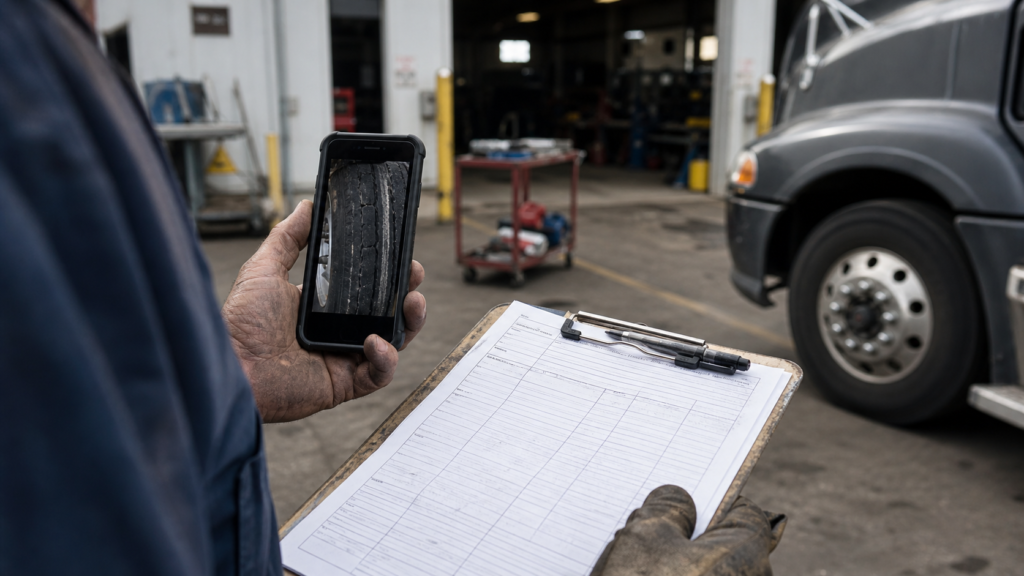
Drivers must complete a Driver Vehicle Inspection Report at the end of each driving day. The DVIR covers 19 specific vehicle components. These include brakes, tires, lights, steering, and coupling devices. If the driver finds a defect that affects safe operation, the vehicle stays parked until repaired.
The repair must be documented. The driver must sign off acknowledging the repair before operating the vehicle again. That sign-off chain is what auditors check. A DVIR without a corresponding repair record for a reported defect is a violation.
Here is where paper falls apart. A driver texts a photo of a damaged tire to dispatch. Dispatch calls the shop. The shop fixes the tire. Nobody updates the DVIR. The paper form says “defect reported.” Nothing says “defect repaired.” Three weeks later, an auditor finds the gap.
Annual Inspections and Preventive Maintenance Schedules
Every CMV requires an annual inspection performed by a qualified inspector per Appendix A of 49 CFR Part 396. The inspection report must be kept on file for 14 months. A copy or decal must remain on the vehicle.
Preventive maintenance schedules vary by fleet. FMCSA does not prescribe exact intervals. It requires that a systematic program exists and is followed. Build your PM schedule around manufacturer recommendations and operating conditions. Document every service event.
Every oil change and every brake adjustment goes into the record. Every tire rotation goes into the record.
A maintenance program on paper means nothing if the records are scattered across three spreadsheets and a filing cabinet. Auditors want to see a consistent, retrievable system.
Drug and Alcohol Testing and FMCSA Clearinghouse Compliance
Part 382 requires drug and alcohol testing for all CDL drivers. The testing categories are non-negotiable: pre-employment, random, post-accident, reasonable suspicion, and return-to-duty.
Random testing must hit a minimum rate of 50% for drugs and 10% for alcohol annually across your driver pool. The selection process must be documented as scientifically valid and random. Cherry-picking drivers is a violation.
Clearinghouse Queries: The 2026 Enforcement Reality
The FMCSA Drug and Alcohol Clearinghouse requires carriers to run queries on every driver. A pre-employment full query is required before hiring. An annual limited query is required for every active CDL driver. Carriers that skip annual queries face per-driver fines.
In 2026, CVSA inspectors cross-reference Clearinghouse data during roadside inspections. A driver with an unresolved violation in the Clearinghouse creates an immediate out-of-service order. The carrier also takes a violation.
Run your annual limited queries in January. Get them done early. Do not wait until the DOT knocks.
What Triggers a DOT Audit and How to Prepare for a Compliance Review
Audits do not happen at random. FMCSA uses specific triggers to prioritize which carriers to review.
Common Audit Triggers
The most frequent triggers include high crash rates relative to fleet size and deteriorating CSA BASIC scores. Complaints filed against your carrier also initiate reviews. New entrant carriers receive a mandatory safety audit within the first 18 months of receiving operating authority.
A fatal crash involving your vehicle almost guarantees an investigation. Post-crash investigations dig deep into the driver’s file. They also examine maintenance history and HOS compliance for the preceding months.
Self-Audit Checklist Before FMCSA Shows Up
Run a self-audit quarterly. Do not wait for a letter from FMCSA. Here is the sequence:
- Pull every active DQF. Confirm all six required documents are present and current.
- Run Clearinghouse limited queries for any driver missed during the annual cycle.
- Review ELD data for unassigned driving time in the past 60 days.
- Check DVIR completion rates. Flag any vehicles with gaps in daily inspection reports.
- Confirm annual vehicle inspections are current for every unit in the fleet.
- Verify insurance filings and UCR registration are active.
- Audit random drug testing selection records to confirm the pool and rate are compliant.
Each step takes one person about 15 minutes per driver or vehicle. For a 50-truck fleet, that is roughly 25 hours of manual work per quarter. Most fleets skip it because the labor cost feels too high. The fine for skipping it is higher.
DOT Regulations 2026: Key Rule Changes Fleets Need to Act On Now
Every year brings regulatory updates. 2026 has several that demand immediate attention from fleet operators.
CVSA Out-of-Service Criteria Updates
The Commercial Vehicle Safety Alliance updates its out-of-service criteria annually. In 2026, expect tighter enforcement on brake adjustment limits and lighting defects. Vehicles flagged during roadside inspections under the new criteria face immediate grounding. Repairs must be verified.
Train your drivers on the updated criteria. A driver who catches a brake issue during pre-trip saves you the cost of a roadside OOS order. They also cut CSA points.
Medical Certification and MVR Cross-Referencing
States are tightening the integration between medical certification databases and MVR systems. A lapsed medical card now downgrades a CDL status faster than in previous years. Your driver goes from “certified” to “not certified” without warning. That happens if you do not monitor MVR data.
NAFA organized a 2026 DOT compliance mid-year outlook event to prepare fleets for these incoming changes. The event assembled regulators and fleet operators to share updated checklist templates and automation workflows. Fleet leaders who attended received current compliance checklists. They also reduced manual research time.
Enforcement Posture Shift Toward Data-Driven Targeting
FMCSA is investing in data systems that flag carriers based on pattern analysis. It is not just crash rates anymore. The agency is looking at inspection violation trends, Clearinghouse query compliance rates, and insurance lapse patterns. Carriers that generate consistent signals get prioritized for review.
Your best defense is clean data. Not clean-looking data. Clean, verified, current data across every compliance area.
Common DOT Violations, Fines, and the Corrective Actions That Fix Them
Knowing the fine amounts motivates action. Knowing the corrective action prevents repeat offenses.
| Violation | Fine Range (per occurrence) | Corrective Action |
|---|---|---|
| Incomplete DQF | $1,270 to $12,695 | Complete missing documents within 10 business days |
| HOS / ELD Violation | $1,270 to $16,000 per day | Assign unassigned time; retrain drivers on log edits |
| No Annual Vehicle Inspection | $1,270 to $12,695 | Schedule inspection immediately; ground vehicle until complete |
| Drug/Alcohol Testing Failure | $5,000 to $16,000 | Remove driver from safety-sensitive duties; initiate SAP referral |
| Clearinghouse Query Non-Compliance | $1,270 to $16,000 | Run missing queries; document completion dates |
| DVIR Not Completed | $1,270 to $12,695 | Implement daily DVIR verification process |
| Operating Without Authority | Up to $25,000 | Cease operations; reinstate authority before resuming |
Every fine on this table is preventable. The corrective action column tells you exactly what to do after the violation. The smarter move is doing it before.
How Compliance Gaps Erode Your CSA Scores
Every roadside violation feeds into your CSA Safety Measurement System scores. The system groups violations into seven BASICs: Unsafe Driving, HOS Compliance, Driver Fitness, Controlled Substances, Vehicle Maintenance, Hazmat Compliance, and Crash Indicator.
Scores are percentile-based. You are ranked against carriers of similar size. A 50-truck fleet with three HOS violations in six months scores worse than a 500-truck fleet with the same three violations. Size matters. Volume matters more.
High percentile scores in any BASIC invite FMCSA intervention. They also invite insurance underwriters to raise your premiums or drop your coverage entirely. Your DOT compliance checklist prevents fines. More importantly, it protects your insurability.
Who Owns What: Role-Specific Compliance Responsibilities
Compliance fails when nobody owns the task. Clear accountability by role eliminates the “I thought someone else handled it” problem.
Fleet Manager / VP of Ops: Owns the compliance program top-down. Sets audit cadence. Reviews CSA scores monthly. Signs off on quarterly self-audits.
Safety Manager: Maintains DQFs. Pulls MVRs. Runs Clearinghouse queries. Manages the drug and alcohol testing program. Trains drivers on regulatory updates.
Maintenance Manager: Owns PM schedules, annual inspections, and repair documentation. Verifies the DVIR defect-to-repair chain daily.
Dispatcher: Monitors HOS compliance in real time. Flags drivers nearing violations. Confirms ELD data has no unassigned segments.
Driver: Completes pre-trip and post-trip DVIRs. Maintains a current medical certificate. Reports defects immediately. Signs off on repairs before operating the vehicle.
Every person on this list needs to know their retention deadlines. Every person needs access to the records they own. Spreadsheets and filing cabinets do not provide that access fast.
The Manual Compliance Burden Is the Real Risk
Look at the checklist above. Count the individual tasks. Count the documents. Count the deadlines. Now multiply by every driver and every vehicle in your fleet.
A 50-truck operation with 60 drivers generates hundreds of compliance touchpoints per month. DVIRs alone produce 3,600 forms per quarter. Each one needs a signature and a defect check. Each one needs a repair log if a defect exists. Each one must be retrievable within minutes during an audit.
Paper binders do not scale. SMS photos sitting in a dispatcher’s phone do not create an audit trail. Spreadsheets updated weekly go stale the next day. That 30-day-old export in your “compliance dashboard” is a report in costume. It looks like visibility. It is a snapshot of a reality that no longer exists.
Manual follow-ups are where compliance breaks. The dispatcher sends a text: “Did you do your DVIR?” The driver responds: “Yeah.” No photo. No timestamp. No verification. That exchange has zero audit value.

The Dashboard Era Is Over. The Ontology Era Has Started.
Manual follow-ups are obsolete. The dispatcher-to-driver text chain that ends with “yeah I did it” does not protect your fleet. It protects nobody. The compliance gap between what your dashboard shows and what happened on the road is where fines live.
Truzer.ai replaces that gap with an AI Bot that checks in with drivers via SMS. No new app to download. No training sessions. No login credentials to manage. The driver receives a text. They reply “YES” and attach photos directly to the Bot.
The AI Bot logs the photo. Then it semantically validates the image. A photo of a tire gets checked against the expected inspection item. A hazmat placard photo gets cross-referenced against UN numbers on the manifest. The Bot knows what it is looking at. It flags mismatches instantly.
Every photo and every validation gets logged into the ontology. The ontology is not a dashboard. It is a unified digital twin of your entire operation. Every data source connected. Every compliance record linked to the driver, the vehicle, the route, and the timestamp. Immutable. Auditable. Current.
The result: 100% compliance logging with zero manual paperwork. An audit trail that an FMCSA investigator can verify in minutes. No binders. No scramble.
Truzer deploys in 48 hours. Your fleet goes from paper checklists and stale dashboards to a living compliance system that validates itself. The DOT compliance checklist does not shrink. The work required to keep it current does. See how Truzer connects your fleet’s compliance data into a single control tower.