
What Is Cold Chain Logistics?
Cold chain logistics is a temperature-controlled supply chain. It manages the storage and transport of perishable cargo. Operators use it to prevent product spoilage and maintain strict regulatory compliance.
Core elements of cold chain logistics include:
- Refrigerated Warehousing: Facilities lock down specific temperature zones for sensitive inventory.
- Thermal Transport: Carriers move freight using active refrigerated units and passive insulated packaging.
- IoT Temperature Monitoring: Live sensors track cargo conditions and flag thermal excursions instantly.
- Compliance Logging: The system records an immutable temperature history to satisfy regulatory audits.
- Dock Operations: Handlers execute fast facility transfers to prevent ambient exposure.
This guide is built for operations leaders, supply chain directors, and pharmaceutical logistics teams responsible for moving temperature-controlled freight in 2026. By the end, you will know what cold chain logistics controls, how a reliable operation is built step by step, where the failures hide, and what a world-class technology stack looks like this year.
Table of Contents
What Cold Chain Logistics Actually Controls
A cold chain is not a single reefer truck. It is a sequence of interconnected temperature-controlled environments, each held to a specific band, connected by handoffs. Every handoff is a gap. Every gap is an excursion waiting to happen. The discipline of cold chain logistics exists to close those gaps before cargo is compromised.
The cargo classes that depend on this discipline span industries. Pharmaceuticals, vaccines, biologics, and cell and gene therapies require tight temperature bands documented to regulatory standards. Fresh produce, dairy, and frozen food operate on thinner margins where spoilage is a direct P&L hit. Cryogenic materials and temperature-sensitive chemicals carry risk profiles that extend beyond financial loss into safety and compliance territory.
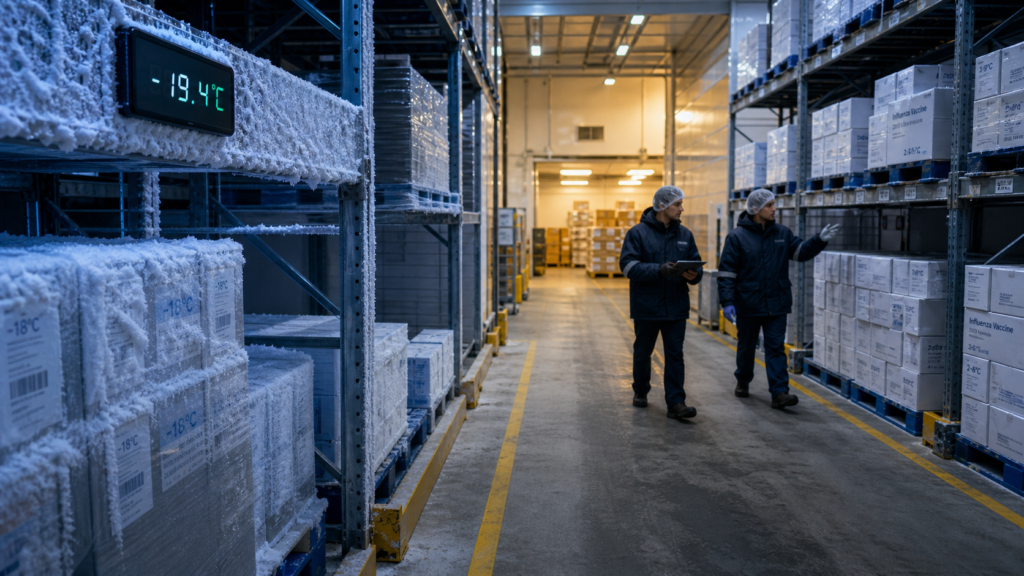
Temperature bands define the operating rules. Frozen cargo holds at -18°C or below. Chilled vaccines, biologics, and insulin sit in the 2-8°C range, the most common band in pharma cold chain operations. Controlled room temperature cargo sits at 20-25°C under USP, with allowable excursions between 15-30°C. That band sounds forgiving until a trailer sits in a Texas staging yard in July. The operator who treats all cold chain cargo the same will fail at all of it. Each band demands its own packaging, its own monitoring thresholds, and its own handoff protocols.
The Three Main Components of a Cold Chain
Every cold chain, regardless of cargo class or geography, rests on three components. Remove one and the chain breaks. Weaken one and the excursion hides until it surfaces as a customer complaint, a batch recall, or an audit finding.
| Component | What It Covers | Why It Fails |
|---|---|---|
| Temperature-controlled storage | Warehouses, cross-docks, freezers, refrigerated holding rooms | Door management, power loss, stacking that blocks airflow |
| Refrigerated transport | Reefer trucks, temperature-controlled containers, last-mile vehicles | Unit failure, door-open events, incorrect pre-cool before loading |
| Monitoring and documentation | Sensors, data loggers, chain-of-custody records | Gaps between handoffs, manual logs, post-delivery-only monitoring |
The three components only work if they share one source of truth across every handoff. A warehouse temperature log that does not connect to the transport record leaves a gap. That gap is where cargo gets compromised and regulators find violations.
The Two Types of Cold Chains: Active vs. Passive
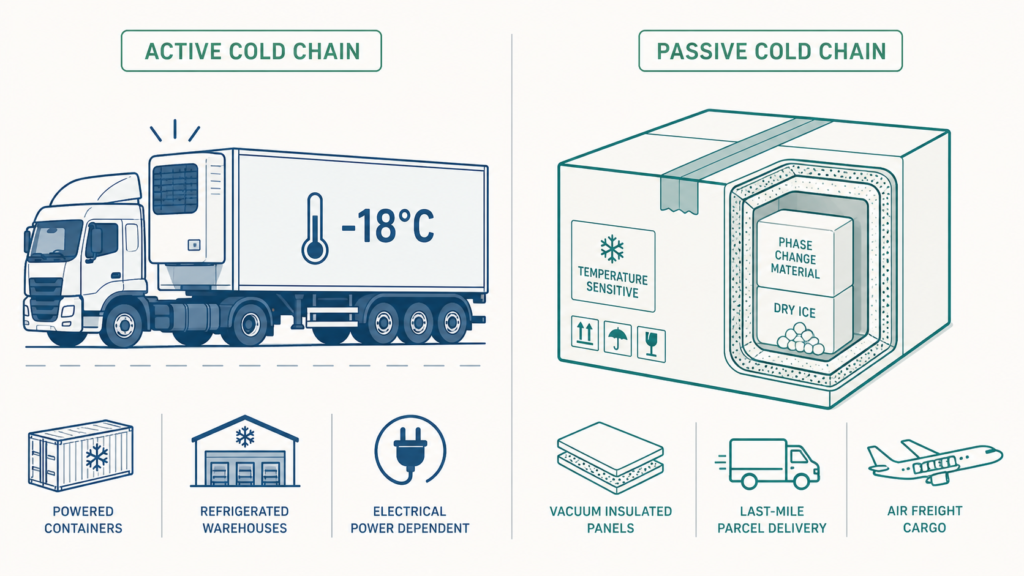
The two types of cold chains are active and passive. This distinction shapes every packaging decision, every routing decision, and every cost model in temperature-controlled logistics. Operators who confuse the two end up with over-engineered packaging on short runs or under-protected cargo on long hauls.
| Type | How It Holds Temperature | Best For | Failure Mode |
|---|---|---|---|
| Active cold chain | Powered refrigeration units that actively maintain temperature (reefer trucks, powered containers, refrigerated warehouses) | Long-haul, bulk volume, multi-temperature mixed loads | Power failure, generator outage, compressor failure |
| Passive cold chain | Pre-conditioned insulated packaging with phase-change materials, vacuum-insulated panels, or dry ice. No power source. | Short-duration shipments, last-mile, air freight where active refrigeration is restricted | Conditioning time expires, packaging compromised, ambient exposure too long |
Most real-world cold chains use both. A pharmaceutical shipment rides an active reefer truck between two warehouses and finishes the last mile in a passive parcel at 2-8°C. The transition point between active and passive is one of the highest-risk handoffs in the entire chain. Operators who do not define a maximum transition time at that handoff are gambling with product integrity.
How to Build a Reliable Cold Chain Operation in Five Steps
A reliable cold chain operation is built on process discipline, not equipment purchases. The five steps below follow the sequence that operators who run real reefer fleets follow. Skip a step and the operation develops a blind spot that surfaces under pressure.
Step 1: Map Temperature Requirements by SKU
Start with the product, not the equipment. Every SKU has a defined acceptable temperature range, a maximum excursion time, and a regulatory classification. Document these in a single reference table before purchasing a single data logger. Cross-reference each SKU against the relevant standard: USP <659> Packaging and Storage Requirements and USP <1079> Storage and Transportation of Finished Drug Products for pharmaceuticals, FDA Food Code danger zone of 5°C to 57°C for food products. This reference table becomes the operating manual for every packaging, routing, and monitoring decision downstream. Without it, the operation is guessing.
Step 2: Select and Validate Packaging
Passive systems use phase-change materials, vacuum-insulated panels, and pre-conditioned coolants. Active systems use powered refrigeration. The choice depends on transit duration, ambient exposure, and cargo value. Run thermal qualification testing against ISTA 7D or the newer ISTA 7E, which simulate real transit ambient profiles rather than lab conditions. Document every qualification result. Regulators, auditors, and insurance carriers will ask for it. A packaging system that passed qualification in a 20°C lab but ships through a 38°C tarmac in Dubai has not been validated for the route it runs.
Step 3: Deploy Continuous Monitoring with Real-Time Alerts
Traditional USB data loggers record temperature but only reveal excursions after delivery. By then the damage is done and the product is already at the customer’s dock. Cloud-connected IoT sensors changed the equation. A live feed turns every handoff into a decision point instead of a post-mortem. Place sensors at the warmest and coldest points inside the cargo space. A single sensor at the unit’s return air vent tells you what the refrigeration unit sees, not what the cargo experiences.
Step 4: Standardize Handoff Protocols
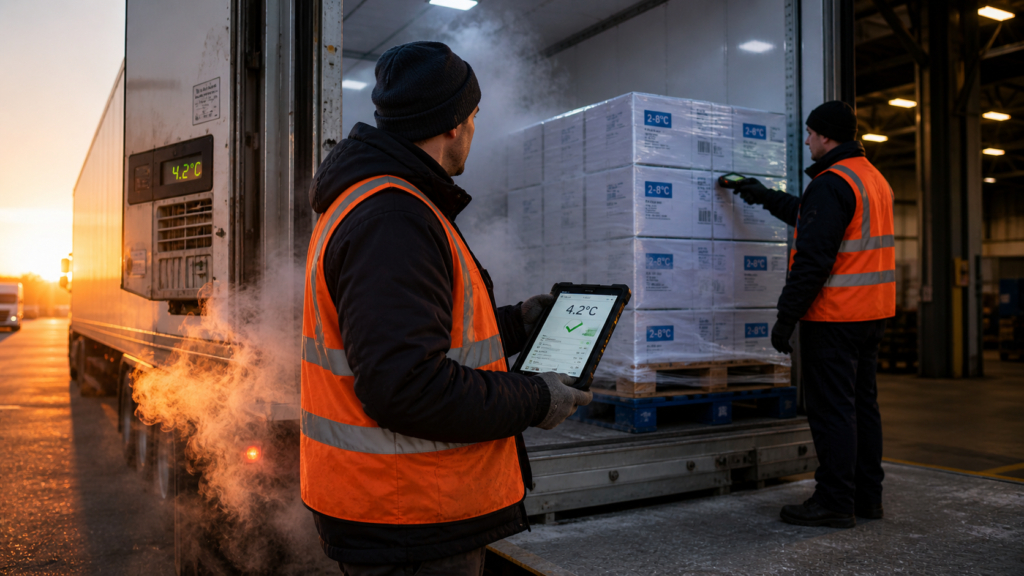
Every handoff is a temperature gap waiting to happen. A common operator rule: cap door-open time at 15 minutes for frozen and tighter for chilled pharma. Train dock workers to stage cargo in pre-cooled areas before vehicle arrival. Record every handoff with a timestamped temperature reading to maintain chain of custody. In our experience building control towers for cold chain operators, the handoff protocol is where most excursions originate. A pre-departure compliance screening that confirms temperature, packaging integrity, and documentation completeness before the trailer leaves the dock catches the failure before it rides 400 miles down the highway.
Step 5: Audit, Analyze, and Close the Loop
Cold chain operations are never finished. Run quarterly SOP audits. Pull random sample shipment records and verify they stayed within spec from origin to destination. Analyze excursion data for patterns. If 40% of temperature events happen between 2 PM and 4 PM at a specific cross-dock, the root cause is a door management issue at shift change. Fix the process, not the symptom. The operators who close the loop between excursion data and SOP revisions are the ones who hold margin year over year.
What Happens When the Cold Chain Breaks
A broken cold chain does not send a warning. It sends a loss. The failure modes below are the ones that show up in post-mortem reviews, audit findings, and insurance claims.
Product Integrity Loss
A single temperature excursion event above or below the required range can destroy product integrity. The biopharma industry loses roughly $35 billion a year to temperature-controlled logistics failures, according to the IQVIA Institute for Human Data Science. A cell therapy dose worth six figures can be written off by one bad handoff at a cross-dock. For frozen food the loss is financial. For biologics the loss is absolute.
Regulatory Violation
21 CFR Part 211 Subpart J requires distribution records tied to lot number, consignee, and shipment date. EU GDP Chapter 9 requires documented proof that medicines were not exposed to conditions that could compromise quality during transport. A single gap in the temperature record can invalidate an entire shipment, trigger batch recall, and expose the shipper to audit findings or warning letters. The documentation burden is not a side task. It is the legal backbone of the operation.
Irreversible Loss in Biologics and Reproductive Materials
Operations like IVF courier services transport cryogenically frozen embryos where a single lapse is irreversible. There is no rework. There is no replacement batch. The loss is permanent and deeply personal to the patient on the other end of the shipment. Cold chain failures in these cargo classes are not recovered. They are avoided.
The Technology Stack for 2026 Cold Chain Logistics
The technology stack for cold chain operations in 2026 is built on three layers. Each layer feeds the next. A gap in any layer leaves the operator reacting to losses instead of preventing them.
Sensing and Connectivity
IoT temperature probes now cost well under $50 per unit at scale, and cheaper still at BLE range. They connect via cellular, Bluetooth, or satellite depending on the route. Ocean freight presents the hardest connectivity challenge, with sensor data often buffered until the vessel reaches port. Global Market Insights valued the global cold chain logistics market at USD 382.3 billion in 2025, and a significant share of that spend is flowing into sensing infrastructure. GPS integration ties temperature data to location data. An excursion without location context is a data point. An excursion at a known problem facility is an actionable decision.
Grounded Intelligence and Ranked Decisions
Grounded models flag excursion risk before departure. The model reads historical temperature data, ambient weather forecasts, route plans, and known facility performance to score each shipment’s risk. High-risk shipments get additional packaging, faster routing, or both. Operators who have run real reefer fleets know the difference between a dashboard that displays a number and a control tower that ranks the next decision.
Truzer gives cold chain operators a real-time visual control tower for every temperature reading, every handoff, and every exception, grounded in an ontology that is the single source of truth for the whole operation. The ontology is the digital twin of the operation. Decisions over dashboards. One ontology, one operational truth, zero dashboard silos.
Closed-Loop Action
The technology only pays off when it closes the loop. A sensor reading that does not produce a decision is a dashboard. A sensor reading that produces a ranked action with an owner and a deadline is a cold chain operation that holds. The closed loop connects the sensing layer to the decision layer to the human who reroutes the trailer, adjusts the packaging, or rejects the load at the dock. Without that final connection, the data is decorative.
Compliance Frameworks That Govern Cold Chain Logistics
Compliance is not a paperwork exercise. It is the receipts that prove the cargo held temperature for every second from origin to destination. The frameworks differ by region and cargo class, but they converge on a single demand: an unbroken, auditable temperature record.
The major frameworks include the **FDA FSMA Sanitary Transportation of Human and Animal Food Rule** for food moving in the US, 21 CFR Part 211 for current good manufacturing practice for finished pharmaceuticals in the US, EU GDP guidelines (2013/C 343/01) grounded in Articles 84 and 85b(3) of Directive 2001/83/EC for wholesale distribution of medicinal products in the European Union, **WHO Technical Report Series No. 961 Annex 9** for the storage and transport of time- and temperature-sensitive pharmaceutical products globally, and **IATA CEIV Pharma** for air freight, the certification pharma shippers ask carriers to hold before a single pallet moves by air. Each framework specifies documentation requirements, temperature thresholds, and audit protocols. The one universal requirement they share is that every temperature reading must be linked to a time, a location, and an accountable party.
Digital logs with tamper-evident timestamps satisfy this requirement more reliably than paper logs. Paper can be lost, altered, or illegible. Digital records, tied to an immutable chain of custody, hold up under audit. The cost of digital documentation is a fraction of the cost of a single failed audit. That is the trade the math makes for you.
Every Handoff. Every Mile.
A reliable cold chain is not a product you buy. It is a discipline you run. The operators who protect margin are the ones who intercept the excursion before the customer calls, grounded in a single source of operational truth. Every handoff. Every mile. All truth, no fiction.
Stop Buying Dashboards. Start Building an Ontology.
Most cold chain visibility tools are just passive dashboards. They show you a temperature graph after the product is already ruined. That is not logistics. That is an autopsy.
Truzer operates differently. Truzer is an AI Integrator. It connects your physical sensors directly to your dispatch records. It builds a single digital twin. This is the Ontology. It is a live semantic model of your entire temperature-controlled network.
Real AI for supply chain operations requires action. When a trailer door stays open too long, Truzer does not just log a data point. The AI Bot texts the dock manager via SMS. It ranks the specific shipments at risk. It forces a corrective action before the cargo temperature breaches the threshold.
This strict control applies to every payload. It protects standard grocery loads. It secures high-stakes IVF courier shipments. No driver app downloads. No passive email alerts. You get an immutable, regulatory-grade chain of custody for every handoff.
Connect your physical reality to your digital twin. Stop paying for excursions you could have prevented.