What Is AI for Supply Chain?
AI for supply chain integrates machine learning and agentic systems into physical logistics networks. It replaces static models with live digital twins. Operators use it to forecast demand and execute procurement decisions instantly.
Core applications of AI for supply chain include:
- Demand Forecasting: The system generates probabilistic forecasts using live sales and external signals.
- Inventory Optimization: It tunes safety stock and reorder points to actual lead-time variance.
- Logistics Routing: Algorithms reroute carriers when ports close or weather shifts.
- Procurement Automation: Policy-bounded agents draft purchase orders and flag deviation risks.
- Supplier Risk: It provides live monitoring for geopolitical and financial disruptions.
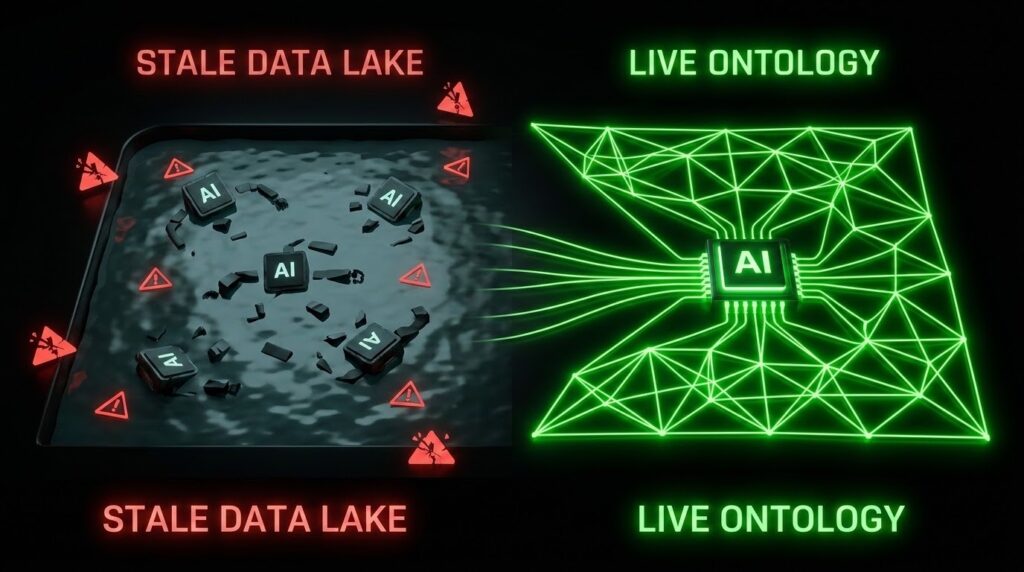
The operators running AI for supply chain well are moving from monthly planning cycles to daily operational response, which is a shift in how the business is run, not just what tool it uses. The CSCO, VP of Supply Chain, or COO owns the decision. Operations, finance, and the board consume the output. What gets replaced is the static forecast, the spreadsheet-driven plan, and the phone-call dispatcher. Run against a live operational model, AI delivers decisions. Run against a stale data lake, it delivers fiction.
Table of Contents
Why AI for Supply Chain Matters More Now
Supply chains now break faster than the monthly planning cycle can absorb. A port strike, a tariff shift, or a carrier insolvency used to be a quarterly problem. In 2026, it is a Tuesday problem. Three forces made this year the inflection point for AI in supply chain.
1. Volatility compressed the planning cycle. Port disruptions, carrier capacity swings, and tariff shifts no longer align to quarterly plans. Response cadence moved from monthly to daily, and you cannot staff your way out of that gap. AI closes it.
2. The data finally exists. Ten years ago, supply chain data sat siloed in TMS, WMS, ERP, and carrier portals, and the integration work to unify it cost more than the AI it would have fed. In 2026, integrated data layers make it feasible to ground AI in live operational reality.
3. The board started asking. Gartner reports top supply chain organizations are using AI to optimize processes at more than twice the rate of low-performing peers. Every operations leader heard the question from their board in the last two quarters. “We are exploring” no longer satisfies it.
Volatility, data readiness, and board pressure all converge on the same answer. AI for supply chain, grounded in a live operational model. Everything else is a demo.
Why Most AI for Supply Chain Projects Fail
Most AI for supply chain projects fail the same way. They run against data that does not describe the operation. Five failure modes show up most: stale data lakes, generic foundation models, ungrounded agents, hallucinated forecasts, and the pilot-trap that dresses all four up as progress.
1. The stale data lake. The AI is trained on data that was already months old when it was loaded. The forecast reflects last year’s demand pattern. The business has since lost its biggest customer and the AI has no signal.
2. The generic foundation model. A general-purpose LLM is pointed at supply chain data with no operational grounding. It answers fluently and wrongly. It confuses lanes with carriers, cases with eaches, and recognized revenue with cleared cash.
3. The ungrounded agent. An agentic AI is given tool access and asked to act, except nobody checked whether the model underneath describes the operation the agent is acting on. So the agent places a PO against a deprecated contract, reroutes a shipment to a port under embargo, or commits inventory the warehouse does not hold.
4. The hallucinated forecast. A generative AI is asked to produce a quarterly forecast. It generates a confident-sounding narrative with invented numbers. The CFO acts on it. The numbers do not reconcile to actuals in week three.
5. The pilot-trap. The business runs a six-month AI pilot on one node. The pilot succeeds. Production deployment fails because the pilot dataset was clean and the production dataset is fragmented across 14 systems.
McKinsey’s State of AI 2025 calls this the gen AI paradox: nearly eight in ten companies use generative AI, and roughly the same share report no meaningful bottom-line impact. That gap comes from production reality, not from model quality.
AI is not the bottleneck. The ontology underneath is. Every shipment, order, supplier, asset, and exception, grounded in one source of truth. The operators getting AI for supply chain right build the ontology first. All truth. No fiction.
Where AI Actually Belongs in the Supply Chain
Connect the data. Ground the model. Act on the truth. That is what AI for supply chain actually looks like once the vendor deck is closed.
AI for supply chain is seven different tools applied to seven different operational decisions. Every AI capability in a real supply chain maps to one of these domains. Anything that does not map is still a science project.
1. Demand forecasting. Probabilistic forecasts that use live sales, promotions, weather, and external signals. Time-series regression on monthly aggregates used to be the whole game. Now the forecast updates weekly with confidence bands, and the signal refreshes as new data lands. This fails without live POS and promotion data feeding the model daily.
2. Inventory optimization. Safety stock and reorder points tuned to actual demand variability and lead-time variance. Static formulas set once per quarter used to run this. The adjustment is now daily, tuned to whatever the variance signal actually says. The thing that has to be in place: integrated inventory, order, and supplier lead-time data.
3. Logistics routing and visibility. Route and carrier selection responsive to live disruption. ETA predictions that account for port congestion, weather, and carrier on-time history. For the full definition of visibility tooling, see our guide on supply chain visibility software. You cannot run this without real-time carrier and shipment tracking feeds.
4. Procurement and sourcing. Policy-bounded agents that draft POs, flag off-contract spend, and compare supplier bids against live market benchmarks. Manual vendor management used to be the whole job. The agent runs the routine now, and the buyer focuses on the exception. What has to be true: a master contract repository the AI can reference.
5. Supplier risk monitoring. Live monitoring of supplier financial health, geopolitical exposure, and performance deviation. The AI reads SEC filings, news, credit signals, and on-time delivery data. It flags the supplier likely to miss before they miss. This only works if supplier performance and external signal feeds are integrated.
6. Warehouse operations. Labor planning, slotting, and exception handling grounded in real throughput. The AI decides which lanes need a second shift tomorrow, based on inbound volume detected today. Live WMS data and labor scheduling feeds have to be in place first.
7. Customer service and order management. Exception narration (why is my order late, plain-English), status queries, and escalation triage. The AI handles tier-1 volume. Humans handle the exception. Keep the precondition in mind: order, shipment, and exception data unified in one operational model.
Where AI does not belong in supply chain (yet):
Strategic sourcing decisions requiring ethical, geopolitical, or reputational judgment. The model cannot weigh a supplier’s human-rights record against a 4% cost advantage. A human owns that call.
Exception handling where the operational cost of a wrong answer exceeds six figures. Approving a labor action, committing to a long-term take-or-pay contract, disclosing a supply disruption to a customer. Agents escalate. Humans decide.
Any decision where the underlying data is fragmented or stale. AI pointed at a stale data lake answers fluently and wrongly. Build the ontology first. Then run the AI.
Seven domains where AI earns its place, three where it does not, and one test that separates them every time. Is the data live, or is it stale? Everything follows from that.
AI for Supply Chain Management vs Supply Chain Optimization
AI for supply chain management is the application of AI to the end-to-end coordination of a supply chain. AI for supply chain optimization is a narrower discipline: the mathematical improvement of specific decisions within that chain.
AI for Supply Chain Management
Management covers the operational breadth: planning, procurement, logistics, warehousing, customer service, and risk. The output is a coordinated operation where every node sees a consistent picture. Management is about the system working together. It does not work without the ontology underneath. Every node reads from it. Every node writes to it.
AI for Supply Chain Optimization
Optimization covers the mathematical depth: linear programming, mixed-integer optimization, and reinforcement learning applied to routing, inventory, and production decisions. Optimization is about a single decision being measurably better than the one the operator would have made without AI. It needs clean, granular data for the specific decision it is trying to improve, and it needs it at the grain the decision is actually made.
A business doing AI for supply chain management without optimization is coordinating a mediocre plan. A business doing AI for supply chain optimization without management is executing brilliance in isolation. Operators need both.
Most AI for supply chain vendors sell optimization. A few sell management. Almost none sell both running against the same live ontology. That gap is the biggest structural weakness in the market today.
Agentic AI in Supply Chain: What It Actually Does
Agentic AI in supply chain is the use of AI agents that plan, decide, and execute narrow operational tasks within defined policy boundaries, against a live operational model.
In 2026, agentic AI handles narrow, policy-bounded tasks. An agent drafts a purchase order when inventory drops below reorder point, reroutes a shipment when a carrier flags a delay, and escalates the exception when a KPI crosses threshold. Every one of those actions sits inside a policy, an escalation path, and an audit trail the operator defined in advance.
Vendors pitch agentic AI as a fully autonomous supply chain that replaces the CSCO and runs the business end-to-end, which is a promise no deployment has held up in production. The operator reality is narrower and sturdier. Agents execute narrow tasks, policy-bounded against a live model, and escalate everything else. The operational discipline around pre-departure compliance screening is a good example: the agent checks, the human approves.
Agentic AI needs a live operational model the agent can reason over, because without one the agent is not executing, it is guessing. Deloitte’s agentic supply chain research documents the same pattern: agents only compound value when grounded in a unified operational ontology.
The industry conversation treats agentic AI as the revolution. That is backwards. The agent is the payoff. The ontology underneath it is the project. The operators winning in 2026 built the ontology first, and even their ordinary agents are competent because of it.
Generative AI in Supply Chain: What It Changes and Does Not
Generative AI narrates. That is the entire job. Conflate narration with forecasting or planning and you end up selling a chatbot as a planner. Used correctly, generative AI handles summarization, exception narration, scenario drafting, and plain-English query.
What generative AI genuinely helps with. Exception narration (“why is order 4492 late?”). Scenario drafting (“what does a two-week Shanghai port closure do to our weekly fulfillment?”). Plain-English query of operational data (“show every supplier on day-60+ of payables”). Board-packet summarization that takes three days of FP&A time down to 45 minutes.
What generative AI does not change. Ask a generative AI to forecast and it produces plausible-sounding numbers that read like one. The CFO who acts on them finds out in week three. This is where pilots collapse and why gen-AI-for-supply-chain has a reputation problem.
What has to be true underneath. The generative model needs to be grounded in a live operational dataset the business actually runs. Ungrounded, the model hallucinates with confidence and no accountability. Grounded, it narrates what is actually happening on the shop floor.
The honest assessment. Generative AI is a speed upgrade for operational communication and nothing more. Pair it with the ontology and it narrates reality. Point it at a stale data lake and it narrates fiction.
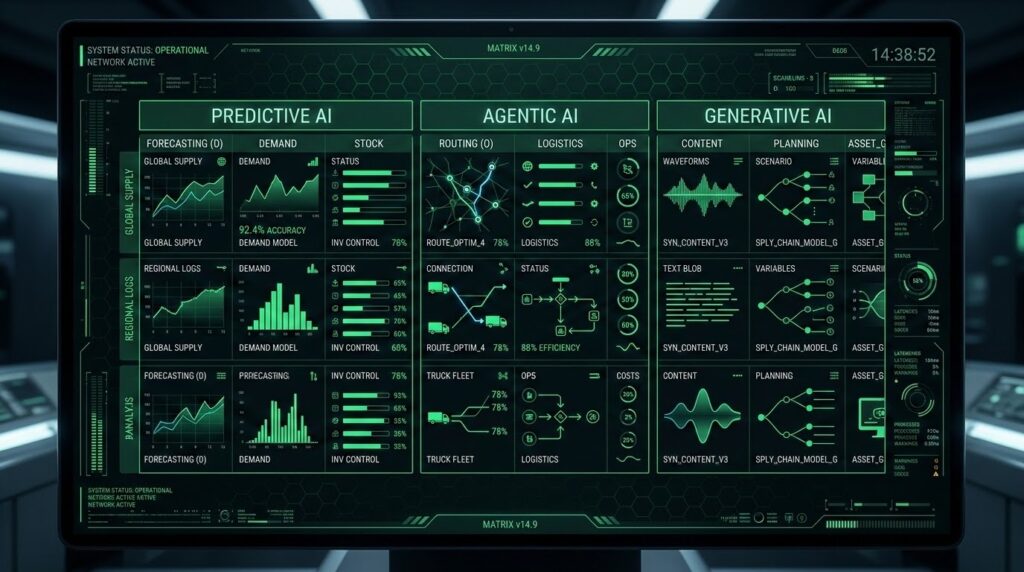
Three AI types, seven domains, one right answer per cell. The matrix below shows where each AI type earns its place.
| Application Domain | Predictive/Optimization AI | Agentic AI | Generative AI |
|---|---|---|---|
| Demand forecasting | Primary | Escalates anomalies | Narrates the why |
| Inventory optimization | Primary | Executes reorders within policy | Narrates exceptions |
| Logistics routing | Primary | Executes approved reroutes | Narrates disruption |
| Procurement | Optional | Primary (policy-bounded) | Narrates contract deviations |
| Supplier risk | Primary | Escalates threshold breaches | Narrates the signal |
| Warehouse operations | Primary | Executes labor/slotting | Narrates variance |
| Customer service | Secondary | Executes tier-1 queries | Primary (narration + plain-English query) |
Read the matrix like this: predictive AI decides the number, agentic AI executes the action inside policy, generative AI explains the result to a human. An operator who runs only one of the three is using a third of the toolkit.
AI in Supply Chain: Real Examples
Five AI-for-supply-chain decisions running in real operations today. Different industries, different AI types, and one thing they all have in common. The data was live before the AI was.
Demand forecast catches a promotion cannibalization (mid-market specialty retailer, ~$400M revenue). The retailer runs a 30% promo on SKU A. SKU B is the substitute. The AI forecast reduces SKU B’s volume by 12% automatically. The merchant planner gets the flag. Inventory rebalances before the stockout.
Routing AI reroutes a shipment around a port strike (global consumer-goods importer, ~5,000 containers per year). A shipment bound for Long Beach. The AI sees strike signals 18 hours before the mainstream news cycle. It proposes a reroute to Oakland. The ops team approves. The container lands three days earlier than it would have.
Agentic procurement catches off-contract spend (industrial distributor, ~2,000 active suppliers). A buyer places an order with a vendor at a non-contracted rate. The agent flags the deviation against the master contract. The order is held for approval. The business saves 8% on the line.
Supplier risk AI flags a supplier before they miss (contract manufacturer, 12-tier supply base). The AI reads the supplier’s 10-Q, their on-time delivery trend, and their news mentions. It flags declining cash, rising customer concentration, and a key-employee departure. The sourcing team engages before the supplier fails.
Generative AI narrates exceptions for the board pack (PE-backed operations-heavy business, quarterly board cadence). The CSCO’s monthly board pack used to take the FP&A analyst three days. The generative AI, grounded in the same ontology that feeds a cash runway narrative, drafts the exception narrative in 20 minutes. The analyst edits for 45 minutes. The board gets the same story, 10 hours earlier.
Five examples across five industries and five AI types, and every one of them only worked because the data was live before the AI was.
How to Start With AI for Supply Chain (In Hours, Not Weeks)
Most AI for supply chain projects take 6 to 18 months to go live. Truzer goes live in 48 hours. The five checkpoints below are what actually decides whether AI for supply chain works. Not a calendar.
1. Name the data sources. TMS, WMS, ERP, CRM, telematics, IoT, EDI, carrier portals. Write the list. Note who owns each source and whether it updates live or on a schedule. This is a 30-minute meeting. Anyone running it as a 15-day audit has missed the point.
2. Pick the decision, not the domain. Demand forecasting is a domain. Catching promo cannibalization on SKU A before it stocks out SKU B is a project. Name the decision the AI will run. Everything else scopes from there.
3. Define what has to be true. What data must be live for this decision to run? What happens if the AI is wrong, and who catches it? If either answer is unclear, the project is not ready. This should take an afternoon. Anything longer means nobody actually knows.
4. Build the ontology. Connect the data sources. Let the ontology build itself. Then point the AI at it. In a Truzer deployment, this step takes 48 hours. In a legacy stack, this is where 14 months disappear.
5. Run. Measure. Decide. Watch the AI against the baseline for two weeks. If it beats the baseline, scale. If it does not, the ontology is incomplete or the decision was scoped wrong. Fix the ontology. Re-run. Do not pilot for 90 days to learn what two weeks would have told you.
The 90-day pilot is how vendors hide that the ontology was never built. Truzer’s 48 hours is the alternative.
How Truzer.ai Approaches AI for Supply Chain
Truzer.ai is built on a different premise than the legacy SCM and BI stack. The agent is the payoff. The ontology is the project. Truzer builds the ontology first.
This is what Truzer believes about AI for supply chain. Data security comes first. Deployed in 48 hours or the premise is broken.
What Truzer replaces. Stale data lakes, dashboard silos, forecasts built on last month’s numbers, and agents pointed at exports that were already two weeks old when they loaded. The legacy stack assembles these pieces into something that looks like AI and answers like a guess.
How Truzer works. Truzer is built as a true, unified digital twin of the business. The ontology. Same thing. Point Truzer at a TMS, ERP, WMS, telematics, IoT, and EDI source, and the ontology builds itself in under 60 seconds. Every shipment, order, supplier, asset, and exception maps to the ontology in real time. Truzer aggregates the complex. The AI runs against the truth of that ontology, which is the difference between a forecast that holds and one that does not.
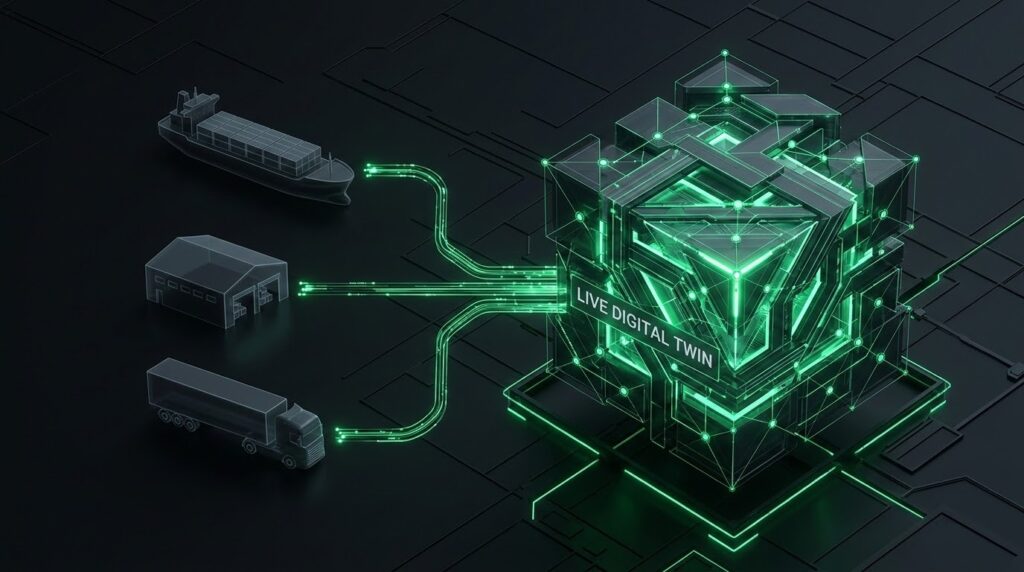
Deployment. 48 hours from first connector to live control tower. No rip-and-replace. No 18-month implementation. No $200K specialist hire. Truzer connects to your existing systems, including Foundry-native deployment paths, and keeps every one of them running.
Security. AES-256 at rest. TLS 1.3 in transit. Scoped tokens with role-based access control. Isolated AI inference. Zero external API calls. Your data never leaves the vault. The AI is grounded in your ontology, which is why the output it produces can be traced back to a source event inside your operation.
Proactive alerts, not passive dashboards. Truzer sends an SMS or email the moment the ontology detects a carrier disruption, a supplier risk signal, or an exception crossing policy threshold. The operator gets told. Nobody has to log in to find out.
That is how AI for supply chain is supposed to work. Build the ontology first. Run the AI against the truth. Decisions over dashboards.